Software Signal Engineering
Quantik Mind™ is the first engineering implementation of a new discipline: using software signals to decide what validation matters now.
The discipline
Software Signal Engineering treats testing as a decision science. Execution becomes the consequence of intelligence, not a substitute for it.
Quantum principles applied to selection
Quantik Mind™ is inspired by the principles of quantum mechanics to model uncertainty and support probabilistic decision-making in complex software systems.
Superposition
Multiple risk paths coexist before selection. The engine evaluates competing possibilities before committing execution.
Entanglement
Services are connected. A change or signal in one area can alter the risk profile of dependent services and tests.
Uncertainty
Where uncertainty is high and impact matters, observation becomes more valuable than brute-force repetition.
Risk changes as the system changes.
Adaptive Risk Intelligence reweights selection using runtime observability, change context, dependency topology, historical outcomes, and service criticality.
Every decision must be inspectable.
Selection only earns trust when teams can see which signals contributed, which tests were selected, what was avoided, and how risk was covered.
How Quantik Mind™ selects.
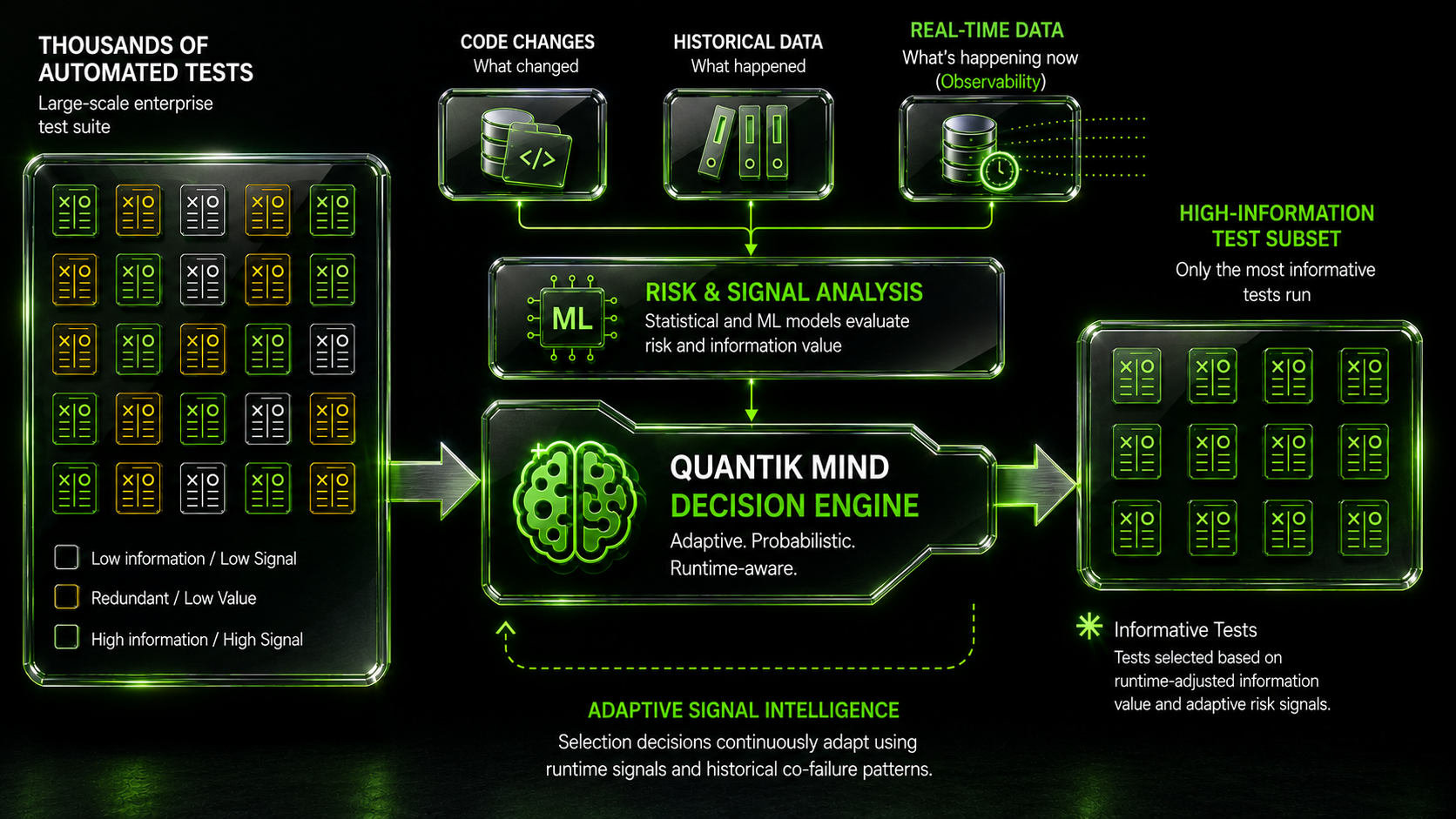
Quantik Mind™ ingests code changes, historical execution data, and real-time observability signals at the same time.
A probabilistic analysis layer evaluates risk, information value, and runtime relevance across the full test suite.
The Decision Engine collapses uncertainty where it matters, producing a high-information test subset instead of a random reduction.
What enters the engine
Code changes, execution history, co-failure patterns, logs, traces, metrics, topology, dependencies, and runtime context.
What “informative tests” means
Informative tests are the tests most likely to reduce uncertainty, expose meaningful risk, or validate critical behavior in the current system state.
What comes out
A selected test subset, risk coverage insight, skipped-test rationale, and explainable reasons for every selection decision.
Start selecting better tests.
Install Quantik Mind™ in minutes and start validating the tests that matter most.